0
USD0.00
0 items
Member Login

The global foreign exchange (forex) market moves over USD 7.5 trillion every day, making it the world’s largest financial market — over 10 times bigger than U.S. equities and 240 times larger than Hong Kong’s stock exchange.
Every second, exchange rate fluctuations ripple through economies and affect the lives of travelers, investors, and even entire governments. A small swing in currency values can disrupt business plans, real estate deals, or overseas investments.
But here’s the question: “Why do currencies move so much? Why isn’t money’s value equal across the world?”
To answer this, we’ll explore:
Not long ago, every banknote represented a fixed amount of gold — this was called the Gold Standard.
In 1821, the Bank of England defined every British pound tied to a fixed weight of gold under the gold standard. Other countries like the U.S., France, and Germany soon followed, creating the Classical Gold Standard Era.
Under this system, a nation could only issue money if it had enough gold reserves. For example, the U.S. pegged USD 1 ≈ 1.5 grams of gold. You could literally exchange your dollar bill for real gold.
This system kept currencies stable — no one could “print money” without backing it with gold.
But after the World Wars and the Great Depression, maintaining gold reserves to support currency issuance has become increasingly difficult, and the gold standard system has gradually declined. By the 1970s, most had abandoned gold and adopted the Fiat Money System, where money’s value is backed by government decree, not gold.
Because there are no physical assets backing it, no wonder the author of Rich Dad Poor Dad, Robert Kiyosaki describes ‘fiat currency’ as ‘Fake Money’.
Without the golden anchor, currency values now depend purely on market trust — or in simple terms, supply and demand.
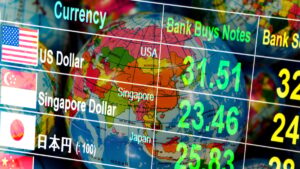
Inflation erodes a currency’s purchasing power: When prices rise, money buys less.
A classic example is Zimbabwe, where hyperinflation turned millionaires into paupers overnight. In the 1980s, 1 Zimbabwean dollar was worth more than 1 U.S. dollar. By the 2000s, USD 1 equaled 600,000 Zimbabwean dollars.
When people lose faith in a currency’s stability, demand collapses and so does its value.
When a country raises its interest rates, investors rush to buy its assets, increasing demand for its currency.
For instance, if U.S. interest rates exceed those in Germany, global investors are likely to sell euros in favor of U.S. dollars, redirecting their capital into U.S.-based assets. This dynamic played out vividly in recent years when the U.S. implemented aggressive rate hikes, totaling over 5%. The U.S. Dollar Index (DXY) surged from approximately 96 in early 2022 to a peak of around 114 by September—a remarkable 19% increase. Meanwhile, currencies like the euro and Japanese yen hit their lows during this period.
However, high interest rates are a double-edged sword. While they draw in foreign investment, excessively high rates can strain economies. Interest rates reflect the cost of borrowing, and when they climb too steeply, homeowners face burdensome mortgage payments, businesses grapple with financing challenges, and overall economic growth may decelerate. Central banks, therefore, rely on economic data to strike a balance in their rate-setting decisions.
This tension explains why figures like Trump have publicly pressed the Federal Reserve to lower rates.
Foreign direct investment (FDI) strengthens a currency.
When multinational companies invest in a country, they must buy local currency to build factories, hire staff, and operate. For example, China’s Open Door Policy (1978) brought massive FDI inflows, boosting demand for the Chinese Yuan and fueling rapid growth.
Similarly, most countries in East Asia and Pacific like Vietnam, Philippines, and India have attracted foreign capital by maintaining political stability and clear tax rules — both of which support strong currency performance.
Exports increase demand for a nation’s currency, while heavy imports create selling pressure.
Another key factor is international trade. For example, when Japan exports cars, importing countries need to buy more yen to pay for them. Similarly, if Hong Kong imports Iberian ham from Spain, it’s euros all the way. At first glance, it seems like the more a country exports, the stronger its currency gets due to higher demand. But it’s not just about exports, it’s about the demand for a currency to settle transactions.
Take the classic case: after the Fourth Middle East War, the U.S. struck a deal with Saudi Arabia to use U.S. dollars for oil trades. This “petrodollar” system, later adopted by other OPEC nations, cemented the dollar’s dominance in global oil markets. That massive demand helped make the dollar the world’s reserve currency.
Some nations maintain stability by pegging their currencies to stronger ones.
For instance:
While this stabilizes trade, it also limits independent monetary control — the country must follow the lead of the currency it’s pegged to.
Currencies don’t move in isolation but relative to each other. When one strengthens, another weakens.
Traders call these pairs — EUR/USD, USD/JPY, GBP/AUD, etc. The key principle in forex trading is: Buy the strong, sell the weak.
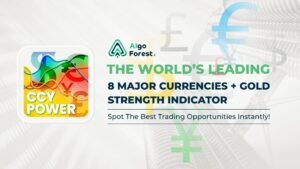
At Algo Forest, we developed a proprietary indicator called CCY Power, which analyzes all 28 major currency pairs + gold in real time to measure relative strength.
It helps traders identify which currency is dominating and which is underperforming — turning complex macroeconomic theory into actionable trading insight.
By using data, not guesswork, CCY Power enables smart, emotion-free trading decisions.
Final Thoughts
The value of modern money is no longer fixed or equal — it’s dynamic, shaped by inflation, policy, trade, and global confidence.
In today’s volatile world, understanding why currencies fluctuate is the first step toward making informed investment decisions whether you’re a traveler, investor, or algorithmic trader.
If you want to learn how to apply currency strength analysis to your own trading strategy, join Wayne Ng’s live Forex Forest workshop.
👉 Click here to register and discover how to turn currency movement into consistent returns.
If you would like to know more on how our modern currencies work, do check out the video below where algorithmic trading expert, Wayne Ng, talks about how do we navigate when trading forex.
*You can click on the CC button and select English for English subtitles