0
USD0.00
0 items
Member Login

For nearly 80 years, the US dollar has reigned as the world’s dominant currency — a symbol of American economic power and a weapon of global influence. It anchors international trade, backs global reserves, and enables the U.S. to enforce sanctions that reach far beyond its borders.
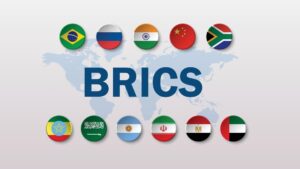
But in 2025, that dominance is under serious threat. The challenge comes from a growing alliance — the BRICS nations: Brazil, Russia, India, China, and South Africa — now expanded to 10 members, including Saudi Arabia, the UAE, Egypt, Iran, and Ethiopia. Together, these countries represent over 4 billion people, 40% of global GDP, and control nearly 44% of the world’s oil production and 70% of rare earth minerals.
This coalition is no longer just a political idea. It’s becoming an economic force capable of reshaping the world’s financial structure.
Over the past two decades, the US dollar’s share of global reserves has fallen from 70% to 58. The decline reflects a growing movement known as “de-dollarization” — the effort by nations to reduce dependence on the dollar in trade and finance. Between 2021 and 2024, trade among BRICS countries surged by USD 700 billion, which has been increased tremendously within 3 years and for the first time, more than half of China’s cross-border transactions were settled in renminbi (RMB) instead of dollars. China’s CIPS payment system (Cross-Border Interbank Payment System) allows direct RMB transactions between banks worldwide — bypassing the SWIFT network long dominated by the U.S. and Europe.
According to the announcement from DBS, RMB settlements jumped 30% year-on-year in 2024, particularly between China, Latin America, and the Middle East — regions where BRICS influence is rapidly growing.
Energy is the backbone of global trade, and BRICS nations are gaining leverage here too.
With Saudi Arabia, Iran, and the UAE joining, the alliance now holds nearly half of the world’s oil output. Combine that with their dominance in rare earth elements — essential for EVs, batteries, and renewable energy tech — and BRICS controls the resources shaping the industries of the future.
This resource control strengthens BRICS’ bargaining power, especially if these commodities are priced or settled in currencies other than the US dollar.
Recent U.S. tariffs under new trade policies have alienated even its former partners like India and Brazil. Both nations faced 50% tariff hikes — prompting India to halt American arms purchases and Brazil to file complaints with the World Trade Organization (WTO).
In response, Brazil’s President Lula da Silva proposed testing a new BRICS currency for international settlements — a potential step toward breaking the global dollar monopoly.
The challenges aren’t only external. Domestically, the U.S. faces rising debt, political gridlock, and credit downgrades.
• U.S. national debt has surpassed $37 trillion — the highest in history.
• Moody’s recently downgraded America’s sovereign credit rating.
The U.S. government has just shut down again after seven years, as Democrats and Republicans failed to pass funding bills which contributed to the budget deadlock.
These factors are eroding global confidence in the dollar.
If BRICS truly manages to achieve a paradigm shift away from the dollar, the logic behind global investment will change enormously — from bonds to commodities — will need restructuring to avoid concentration risk.
In this new era, risk diversification and adaptive investment strategies are no longer optional — they’re essential.
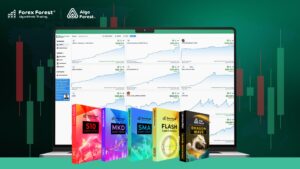
Algo Forest has developed tools for Risk diversification. Leveraging its own developed AI Signals Page to enhance probability and efficiency on trading.
Our team has developed 5 flagship AI-driven Expert Advisors (EAs) — automated trading systems built to navigate volatility, diversify risk, and leverage algorithmic precision.
Whether adapting to new trade dynamics or fluctuating currency valuations, AI-powered trading tools, including but not limited to Dragon Wave, SMA, MKD, Flash, or S10, provide you a smarter, faster way to react to market shifts without coding knowledge.
Additionally, with the recently developed of AI Signals Page by Algo Forest Group, you are now able to see trading signals from other traders! This can reveal strategies that enhances your edge for your trades.
Global financial orders are evolving. De-dollarization, BRICS expansion, and AI trading technologies are shaping the next generation of wealth creation.
👉 We are running a limited time offer where all purchases on our Expert Advisors will receive an exclusive US$100 Trade Loss Voucher on VANTAGE
👉 Visit our AI Signals Page to monitor real-time performance and copy winning signals
Your next profitable trade shouldn’t depend on your emotions.
Let AI trade smarter — while you get consistent, stable results.
Together, let’s trade smarter — and thrive in the new financial era.

If you would like to learn more on how to better navigate this period of financial change, watch our video above to learn more and follow our YouTube – Forex Forest for more content like this!